Commercial doors from the Surprise shops to the Goodyear logistics corridor, serviced on a cycle count
A commercial door that is down is a bay that is closed. Auto shops along Grand Avenue, warehouses off Loop 303, self-storage in every West Valley city and the distribution centers filling the Goodyear corridor all run doors that cycle more in a week than a home door does in a year.
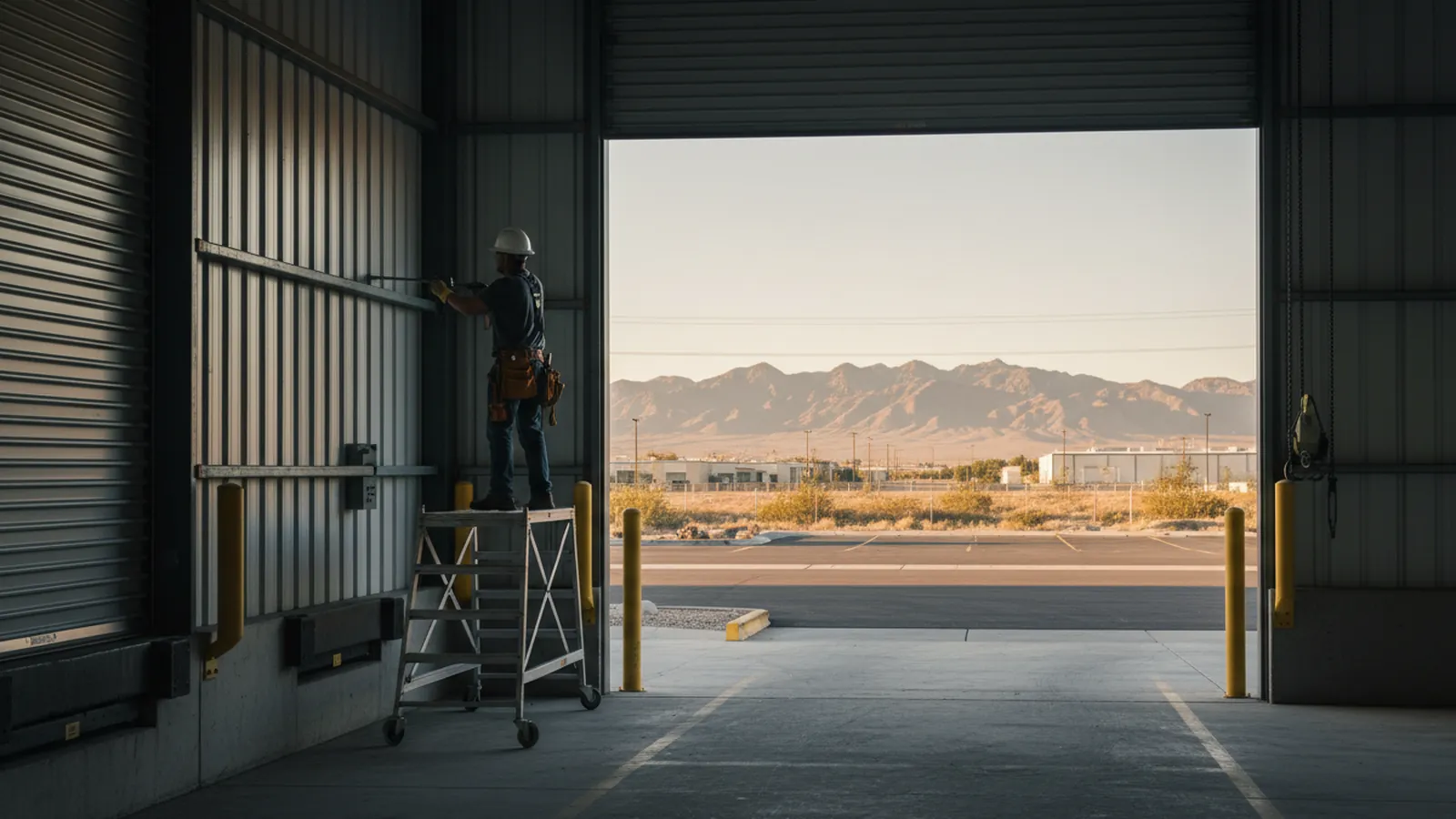
Walk a West Valley industrial park and you will see three kinds of door. The big sectional, steel or aluminum-and-glass, hung on commercial torsion springs that are rated for anything from 25,000 to 100,000 cycles; the forklift finds its bottom section, the springs reach their count, the cables rust at the bracket. The rolling steel curtain, coiled on a barrel above the opening, whose weak points are the spring inside that barrel, the guides the curtain rides in, the bottom bar, and the slats a backing truck crumples. And the vertical-lift or high-lift door in a tall bay, where the cables, drums and operator carry the load. Each is driven by a commercial operator, jackshaft or trolley, with its own limits, its own duty cycle, and, under the current standard, monitored photo-eyes and a safety edge on any door run from a momentary-contact button.
The West Valley adds its own conditions. Dust from the haboobs packs the guides on rolling doors and the bearing plates on sectional ones. Afternoon heat on a south- or west-facing bay pushes operator motors into thermal cutout by 3 p.m. in July, and the fix is often ventilation or a duty-cycle-rated operator rather than a new motor. And the mix of buildings is unusual: fire stations, school bus yards, the Surprise Stadium complex, equipment yards on the edge of farmland west of Loop 303, and the new tilt-up warehouses in Goodyear with a dozen dock doors each.
Service is scheduled around the business. Emergency calls for a door stuck shut or open are answered seven days a week. Planned maintenance runs on cycle count rather than a calendar: springs, cables, drums, guides, bottom bars, operator limits, safety devices and a written inspection report per door for the facility file. New commercial doors are specified for the opening, with the gauge and the wind-load requirement confirmed, and are permitted by the city where a permit applies, under the installing contractor's licence.
How the job is handled
Sectional, rolling, high-lift
Springs, cables, drums, sections, slats, guides, bottom bars and curtains across all three families.
Operators and safety devices
Jackshaft and trolley operators serviced and replaced, limits set, photo-eyes and monitored safety edges brought to current standard.
High-cycle parts
Springs rated 25,000 to 100,000 cycles and heavy hardware for doors that open all day.
Dust and heat accounted for
Guides and bearings cleaned, operators rated for the duty cycle and the bay's temperature.
Planned maintenance
Visits scheduled by cycle count with a written report per door.
Permitted new doors
Specified to the opening and the wind load, permitted where required under the contractor's licence.
Commercial garage door repair: West Valley prices for 2026
| Work | Range | What changes it |
|---|---|---|
| Commercial trip and diagnosis | $115 – $185 | Folded into the repair |
| Sectional door torsion springs, commercial pair | $420 – $1,050 | Cycle-rated to the door |
| Rolling door in-barrel spring replacement | $550 – $1,500 | Two-technician job |
| Slat or section replacement | $230 – $850 per slat/section | Plus labor |
| Commercial jackshaft operator, installed | $1,300 – $3,000 | With photo-eyes and safety edge |
| New sectional commercial door, 10×10, installed | $2,600 – $6,200 | Permit separate where required |
| Planned maintenance visit, per door | $130 – $250 | Quarterly or by cycle count |
Planning ranges for Surprise and the surrounding West Valley cities in 2026. The figure you pay is the one written down on site before the work starts; quotes on replacement doors and new openers are free and hold for 30 days.
From the field
Asked about commercial garage door repair
Do you handle emergency commercial calls?
Yes, seven days a week. A dock door stuck shut or a shop door stuck open is treated as an emergency, with the dispatch fee stated before the truck rolls.
Can you service a rolling steel door?
Yes: in-barrel springs, guides, bottom bars, slats, curtain repairs and the operator. In-barrel spring work takes two technicians and is scheduled as such.
Our operator keeps cutting out in the afternoon.
Thermal overload, common on west-facing bays in summer. Ventilation, shade or a duty-cycle-rated operator fixes it; a new motor on its own usually does not.
What is the safety edge requirement?
Current operator standards call for monitored entrapment protection, meaning photo-eyes and often a monitored safety edge, on commercial doors with momentary-contact controls. Older operators are brought up to it when serviced.
Do new commercial doors need a wind rating?
Yes. Every new door is specified to the design pressure for the opening, which sets the gauge and the wind locks on a rolling door. The permit reviewer checks it where a permit applies.
Can you put our doors on a maintenance schedule?
Yes, quarterly or by cycle count, with a written report per door. It is the cheapest way to keep a dock door out of the emergency column.